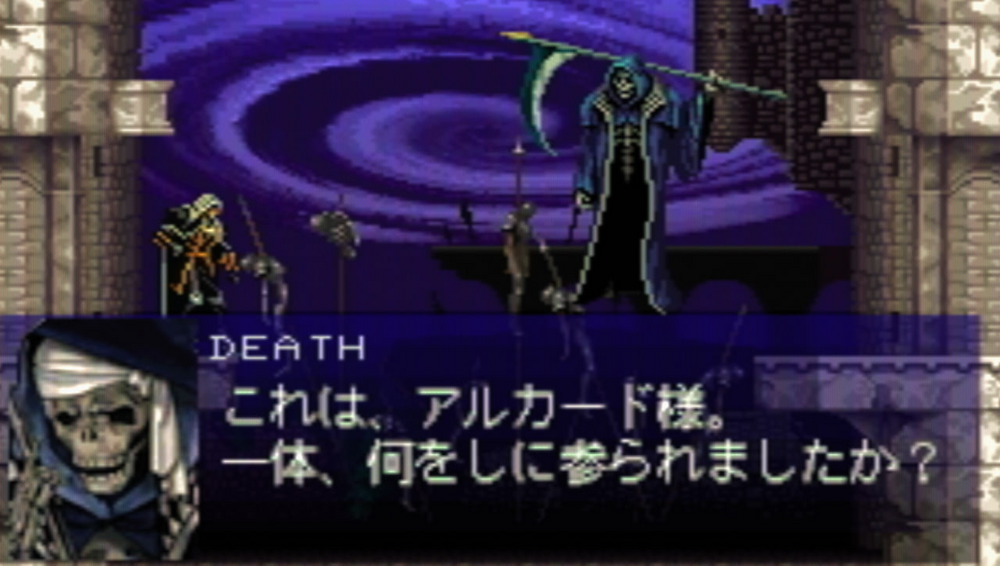
Every now and then I like to launch an old game I've already played (just not in Japanese) to try to learn new things in context. In this case I think I might have stumbled upon a case where the passive conjugation is used to create a sort of ambiguity. Technically, the context at hand strongly suggests the passive is being used as a honorific (the verb なさる is used in the line next to the one shown here, for instance). However, there's a couple of details I think could also lead to interpreting it as the "trouble" passive.
Anyway, the game in question is 「悪魔城ドラキュラX 月下の夜想曲」. At the very beginning, Alucard meets Death, which happens to be the servant of Dracula. This would explain why Death is using the honorific: they're talking to the son of their master. But:
1) In the dubbing, I think the verb at the end is uttered slowly and with emphasis. 2) It is safe to assume Death actually already has an idea about why Alucard is there: to wreck their plans, pretty much. And that's annoying indeed. 3) In the whole dialogue, this is the only case where the honorific passive is used instead of the "standard" 尊敬語. Did that just come out of a whim? Or there's more?
I'm also attaching a link to a video which should take you straight to said dialogue.
(doesn't seem to work, it's 3:26!)
But maybe it's just all in my head and I'm overthinking this.
Hopefully I made my points and question clear, many thanks to anyone who will read or even answer
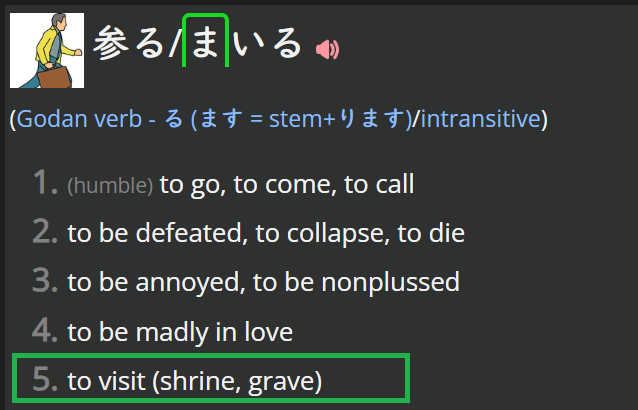
There are three more things that point towards "trouble passive". 1) 一体 (first definition) isn't a polite expression. I recommend taking a look at the example sentences - most of them express irritation. 2) 参る is actually 謙遜語 (humble language), not 尊敬語. 3) Another thing is that even if 参る was honorific, there would be no reason to make it passive for extra respect. Combining a honorific version of a verb with the honorific passive would, in my opinion, sound unnatural or overdone.
To me, this line sounds like mockery, clearly contrasting with honorific language that follows it.
About this part, I think there's a chance 参る in this case is not used as the 謙譲語 verb, but with the following meaning.
Considering the Castle of Dracula could be seen as a massive "grave" where the supreme vampire rests in its own way, I think it could fit. The place could also be seen as a "shrine" by Death given it's a "creation of chaos" according to the lore and yarayara. So if that was the case, we would just have the trouble passive/honorific passive of a "neutral" verb instead.
Thank you for commenting and sharing your thoughts!
I see your point about 参る. Since it's gramatically correct, fits the overall politeness level and makes sense in the story's setting I incline to this analysis as well.
However, 一体 still irks me somewhat. Regardless of whose interpretation I go with, they both sound rather out of tone to me. I also doubt 一体 was somehow meant as "in general" here, as there are other expressions better suited to convey such meaning in this kind of question. I have no strong evidence either for or against any of these options, though.
I guess it all comes down to ambiguity, like you mentioned in your original post.
Thank you for commenting and sharing your thoughts!
Thank you as well. I'm glad to participate in this discussion. :)
However, 一体 still irks me somewhat. Regardless of whose interpretation I go with, they both sound rather out of tone to me. I also doubt 一体 was somehow meant as "in general" here, as there are other expressions better suited to convey such meaning in this kind of question. I have no strong evidence either for or against any of these options, though.
The only thing I can think of is that Alucard was a child at first, and maybe Death was around every now and then. So perhaps, if that's something an おじいさん could say to their 孫 without sounding too harsh in a relaxed context, for a brief moment he still sees the "really young" Alucard, only to then quickly switching to being passive aggressive with the "fake" honorific passive.
The third sentence indicates that 参る + honorific passive is a proper construction after all, albeit old-fashioned and considered inappropriate in modern times, but I suppose it wouldn't be surprising for Death itself to use dated language.
I'm sorry if I only made the topic more ambiguous and confusing.
Theobaldus (06月9日, 0:20 The only thing I can think of is that Alucard was a child at first, and maybe Death was around every now and then. So perhaps, if that's something an おじいさん could say to their 孫 without sounding too harsh in a relaxed context, for a brief moment he still sees the "really young" Alucard, but then quickly switch to being passive aggressive with the "fake" honorific passive. Just a theory ahah
I have no knowledge of the source material except for what you've provided me, so I can base my speculations on dictionaries only. Referring to 日本国語大辞典 this time (link), fragment of section [ 2 ] (ロ):
特に疑問の気持を強めていう場合。また、相手に 詰問 する場合。
It is also possible that Death used 一体 in the second sense instead of the first, unlike I initially assumed. Rather than surprised, irritated or feeling anything else that we suggested, it might have been forceful and direct.