Vocabulary dictionary

Kanji dictionary

Grammar dictionary

Sentence lookup

test
 

Forums - vs

Top > 日本語を勉強しましょう / Let's study Japanese! > Anything About Japanese


avatar
Pixel725
Level: 99

In a context where two people are talking about “nature,” how would 天然 (てんねん) be used differently from 自然 (しぜん)? Thanks in advance

thanks.png
0
1 year ago
avatar

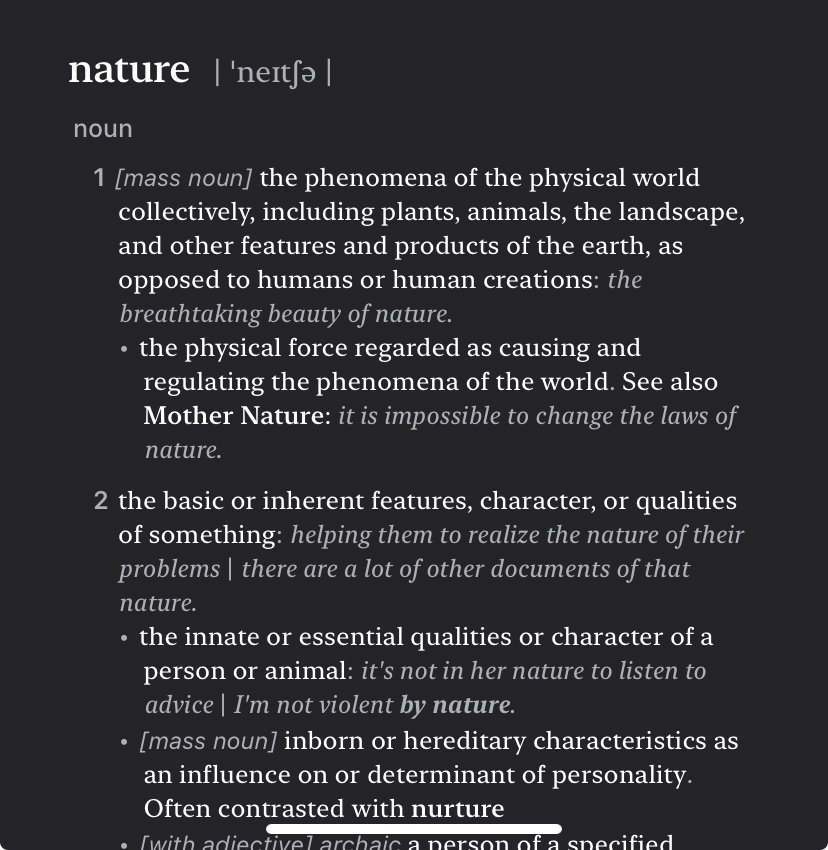
I believe 自然 is more like Mother Nature, and 天然 is more like the nature of a thing, if that makes sense.

These correspond to the two meanings of nature given in the Oxford Dictionary of English:

3a93e1062dbaa016885b48c2.jpg

Certainly, 自然 seems to be more common.

5
1 year ago
avatar
ヤンカミ
Level: 350

This is definitely not exhaustive but is often used for "natural" or "nature" with the nuance that it hasn't been artificially altered. For example, (natural beauty, something that hasn't been touched by makeup or plastic surgery) and 調 (natural seasonings, without artificial preservatives). is also frequently used to describe people, like someone's who's naive and disarming, like they aren't manipulative/with hidden agendas (aka not like @アっくん JUST KIDDING hehe)

Whereas is used if you want to say "nature" at large, like physical environment or the natural environment, as well as behaviors, speech, and situations that happen "naturally" or "spontaneously."

Aside from "physical nature" definition like ("natural environment") and する ("protect the environment/protect nature"), ("nature's beauty" or "natural beauty," like how you would describe a beautiful landscape)...

is used to describe something that flows naturally. Like if you ask if your Japanese sounds correct or natural, you'd frequently hear です as a response, as in, yes, it's natural. You would NOT hear です lolol

(natural reaction) そうなる (it becomes like that naturally)

For these cases you wouldn't use

There are overlaps, but that's the biggest difference in usage I can think of! Hope this helps 

neko_cheer.png
2
1 year ago
avatar
ヤンカミ
Level: 350

By the way, if you want a word like "nature of something" (as in, its inherent quality) it would be more appropriate to use a word like more than or

1
1 year ago
avatar

Thanks for providing the native speaker’s perspective. I also like to consider the data:
天然記念物 natural monument

天然ガス natural gas

天然痘 smallpox, variola

天然温泉 natural hot spring

天然色写真 color photo

天然色 natural color, technicolor

天然資源保護論者 conservationist

天然資源 natural resources

天然ボケ natural airhead

天然港 natural harbor

天然果汁 natural fruit juice

天然塩 natural salts

天然に naturally, spontaneously

天然保湿因子 natural moisturizing factor, NMF

天然自然 natural, naturally

天然香料 natural fragrances

天然ゴム natural rubber

天然キャラ natural airhead

天然由来 naturally-occurring

天然放射性同位体 natural radioisotope
天然繊維 natural fibers

天然染料 natural dye

天然ガラス natural glass

天然型 natural form (of a vitamin, etc.), native form, naturally occurring
天然ウラン natural uranium

天然パーマ naturally curly hair

天然物 natural product, product of nature

天然水 natural (raw) water

天然林 natural forest

天然木 natural wood

天然石 native rock
天然果実 natural fruits

天然橋 natural arch
天然樹脂 natural resin

天然藍 natural indigo

3
1 year ago
avatar
ヤンカミ
Level: 350

Ooh this is so interesting! Thank you for sharing :)

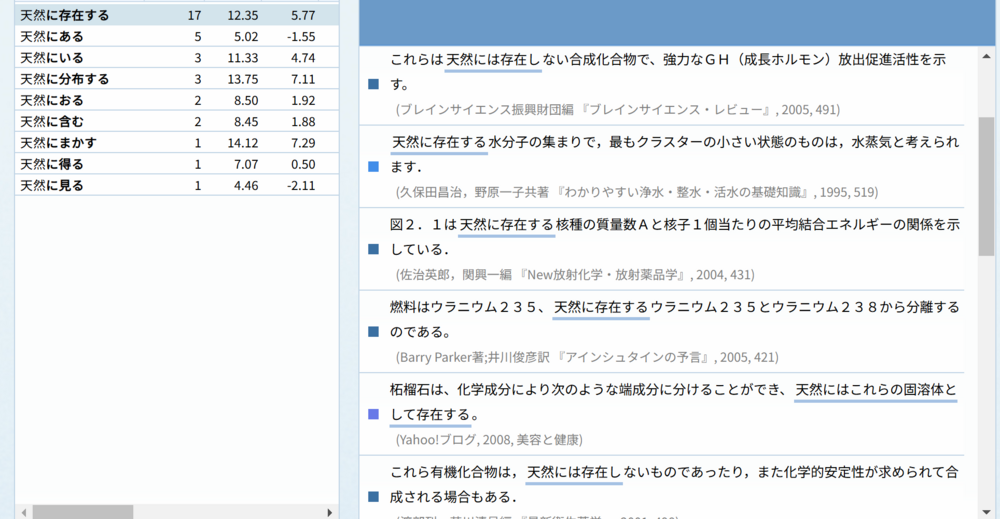
For fun, I looked up に to see how it's used since I haven't come across it. In the NINJAL database, it looks like it's frequently used for contexts like "does not occur/exist naturally or in nature," mostly in scientific literature like "naturally occurring chemical compounds" or certain species that are found "naturally" without human intervention:

bfdf402171bd52c006df21f8.png

You're right, the data is so helpful to consider the nuances of the word since English translations often miss the difference


2
1 year ago
Getting the posts


Top > 日本語を勉強しましょう / Let's study Japanese! > Anything About Japanese


Loading the list
Lv.

Sorry, there was an error on renshuu! If it's OK, please describe what you were doing. This will help us fix the issue.

Characters to show:


Use your mouse or finger to write characters in the box.
■ Katakana ■ Hiragana