It's pretty easy. One thing to tell is the stroke shape and direction.
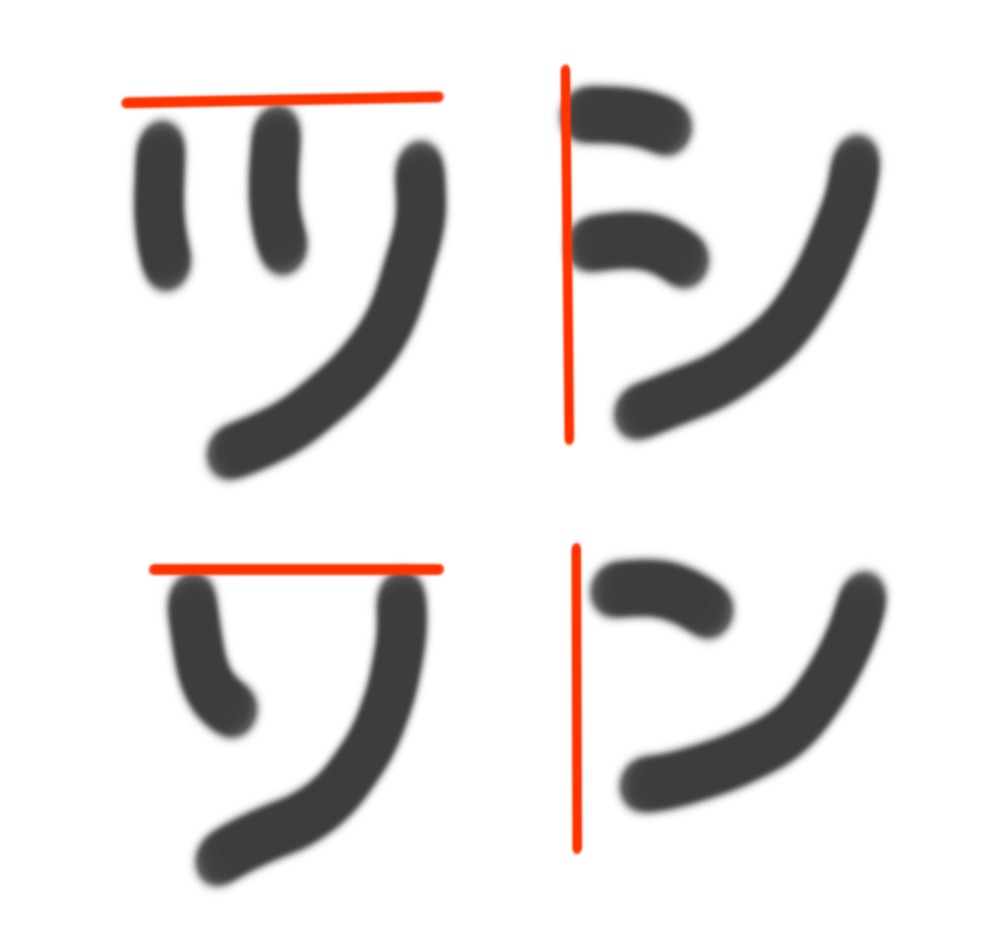
The strokes for ン is like ん from the starting point. It's a top to bottom line that is higher than the other line. ソ then would be different to that as the lines are virtually even, like the horizontal-ish line when you draw the shape of そ.
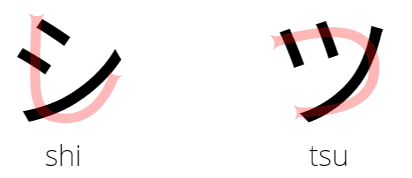
So, ツ and シ are in similar fashion. To start with, シ is し, and the first two strokes are higher than the last one, just like ン. And since し is all about being drawn with a hook shape, the top two strokes have to point in that direction almost horizontally like it wants to go up (but the last stroke is drawn in that direction to finish the job)
This implies ツ is drawn like ソ/そ, so in the process of elimination, it's つ. Another way to see it is that since つ is basically the shape of a TSU-nami. The first two strokes are the tips of the wave that wants to fall straight down. It's at a point it almost wants to crash down, then the last stroke curves like つ, completing the shape of the wave starting almost higher/even from the tip to the bottom.
The way I got them to stick in my mind is to imagine them both facing each other and making them a word, like ンソ (‘and so…’) and シツ (like a shih tzu dog) It’s probably not the most normal way of remembering them but it’s worked for me so far 😅
Idk, if it’s as intuitive to other people as it is for me, but anyway:
The smiley faces that are looking upwards - シ shi and ン n - sound higher in tone so they go “up”, while the faces looking downward - ツ tsu and ソ so - sound lower, so they go “down”.
So it’s just the fact that the sounds u-u-u and o-o-h feel lower and more bass-y, and e-e-e and n-n-n feel high and squeaky, lol. Kinda like bouba-kiki, but for katakana and pitch, I guess🤔
I want to add that all the suggestions above are good.
But some games or books uses font that makes these very hard tell apart. Some words which is usally written in Hiragana can also be written in Katakana so you got to be prepared for that too.
What worked for me in the end is that I simply memorised both the letters as one and then I used the wording which sounds right. Through context, it's actually very easy to tell them apart.
ソファ is not prnounced Nfa and カイブツ is not prononced kaibushi after all.
It might seem ソ hard for you, but it is quite iシ. It'sンot so hard when you see the difference between the four, and I actually struggled with it myself but I learned to tell which is which. If I can do it, you can do it ツ!
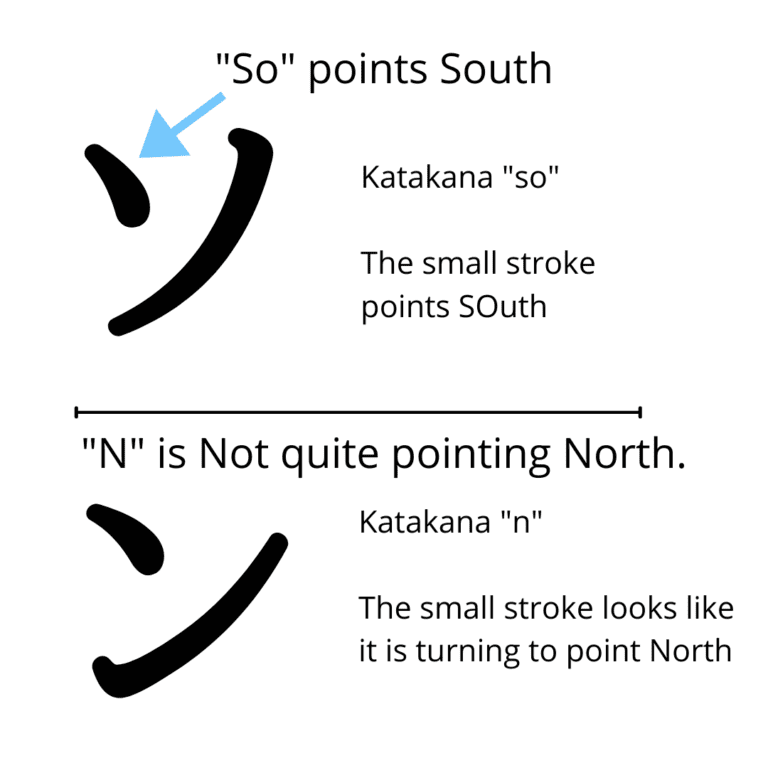
a way of thinking about it is that the tiny lines (i'm bad at explaining, sorry lol) on ソ(so) and ツ(tsu) are tilted upwards. ン(n) and シ(shi) have little lines that are angled more to the side. that's how i personally remembered them, by paying close attention to the way the little lines are angled!! they can be really tricky, but you got this!!
I definitely recommend writing them a lot with the ideas in mind! (At least, that's how I got them straightened out... Now if only I could stop confusing せ サ and セ....).
(At least, that's how I got them straightened out... Now if only I could stop confusing せ サ and セ....).
While this is off from the thread, I can help here since I'm here anyway reading this.
せ and セ are really the same thing. The only thing you could confuse them apart out in the wild is identifying whether it's hiragana or katakana. But that's a minor matter.
They're both se, written like an e, which also helps because se is on the え line. I highlight "same", because to say the pronounciation of "same", the a part is like how you pronounce え. In fact, when you're puzzled by a statement or reacting with surprise follwed by some positive statement to some good news or something ("Huh? What? Oh!"), you might be inclined to say (or mutter to yourself) "え?”. Congratulations, you've made a complete phrase in Japanese, because that's exactly how Japanese people use that word! If you intend to practice it by putting it at the end of a statement, people might think you're Canadian. That's not very Japanese, eh? Watch what you say. I digress.
As for サ, that's sa. One of these is not like the others. The strokes aren't an e, it's not the sa pronounced when you spell "same" or "say". Sa is on the あ line, and for that line, あ is like "ah". サ is kind of drawn like a H, and if you've got that image in your head, you might say "a(h)-hA! SA!". If you jump to that point trying to memorize it, you can just look at サ and think to yourself "SA!". Maybe then it might sense once it's drilled in your head.
What also helps with spelling these days electronically, is that we have some technology called autocorrect, and when you practice typing in any script, autocorrect will give you the choice to use what you type, so that it matches what you're trying to say, and when you pay attention to it, you'd be able to read it as well as using it. That is, if you don't accidently botch it like that guy on reddit who mispelled some word in particular that I can't recall for a number of years without correction. Be careful with that.