Vocabulary dictionary

Kanji dictionary

Grammar dictionary

Sentence lookup

test
 

Forums - い/な adjectives difference

Top > 日本語を勉強しましょう / Let's study Japanese! > Anything About Japanese


avatar
Level: 117

So it's a known fact that there are different types of adjectives, and I know how they work and all, but what is the difference in words like き and さ? When do you use them as an い-adjective and when as a な- adjective? I don't even know if these words are the only multi-adjectives (as I call them:)), let alone how to use them

2
3 days ago
avatar
Icepick87
Level: 623

First, check on your spelling. This is important. The words you're trying to use is spelled きい and さい*. Both of these are い-adjectives.

Second, it's really easy. As I said above, check the spelling. That already tells you what it is right away.

Now, the breakdown on spellings: い-adjectives are just that. It's virtually every adjective that ends with the okurigana, い, except 2 - きれい and (because everyone hates exceptions). These are actually な-adjectives. That's it!

な-adjectives are basically everything else. Even words that are only in kanji!

There's also a third classification, the irregular adjective, which is basically only 1: いい. That sounds confusing, right? It sounds like I should have mentioned this earlier, but believe me, it's not.

The reason いい isn't an い-adjective, and neither a な-adjective, is because it's the only word that sets it apart from the two. When it's conjugated, instead of messing with the last vowel, the whole word changes. It's actually a modern version of い (よい). So everything is based on the form of that word, rather than いい. Don't ask why. Memorize.

*EDIT: I had assumed you meant きい and さい.

The tricky thing particularly with な-adjectives as opposed to い-adjectives is that you must attach the な when you're describing a noun. い-adjectives do not use な.

4
3 days ago
avatar
マイロー。
Level: 334

If you search きな in the dictionary, you can tap a link that lets you compare it with きい. The following explanation is given (written by the user gillianfaith):

"きな & さな mean the same thing as きい & さい, respectively. The ~な versions just have a more literary or quaint feel, and are also often preferred for describing concepts.

There is no situation where きな / さな can be used that it would be incorrect to use きい / さい instead, but the ~な forms have restricted use and are not able to replace the ~い versions in many cases. As a learner, it's good to note that these forms exist, but it's safe to continue to use only きい / さい until you get a sense for what situations きな / さな are preferred in."

9
3 days ago
avatar
Karlla
Level: 910

きな・さな are only used as direct modifiers before nouns.

kao_yes.png きな

kao_no.png きだ

kao_no.png きにげる

きい・さい can be used before nouns, after nouns or as adverbs before verbs.

kao_yes.png きい

kao_yes.png きい

kao_yes.png きくげる

When used in front of a noun, they are interchangeable. For all the rest you have to use the i-adjective version for these two.

5
1 day ago
avatar
Shamugan
Level: 764

Small detail not mention directly but きな・さな are not な-adjective. You can see in the dictionary that they are called "Pre-noun adjective" (In japanese, 連体詞 and... words like じ are also 連体詞). So while, it's true that you can't say きだ, you can use だ for the others.
Like:
きれいだね
So unfortunatly, you choose an exception for your question =p


2
21 hours ago
avatar
Icepick87
Level: 623
Shamugan (052, 12:25)

Small detail not mention directly but きな・さな are not な-adjective. You can see in the dictionary that they are called "Pre-noun adjective" (In japanese, 連体詞 and... words like じ are also 連体詞). So while, it's true that you can't say きだ, you can use だ for the others.
Like:
きれいだね
So unfortunatly, you choose an exception for your question =p

​I was going to make a comment about that (which is why I initially pivoted to the い-adjectives per the question). I just couldn't really figure how to word it yet. I opted for the basic part of the question rather than getting into the example マイロー was leading to. It's also something that I haven't yet studied, so this is taking me a bit to understand it.

So, I can say this is more of a slightly advanced concept for beginners although people are already exposed to such adjectives in their vocabulary. こそあど demonstratives also fit in this classification. Following that, there are some words that also don't have the "な" ending in them, such as る, の, た, が, etc., which may make it difficult to spot the difference.

In dictionaries, な-adjectives may be noted in words by saying "word(な)", which is just a way of saying that な is used in times kind of like a particle when that word is attached to a noun. As a , きな, for example doesn't fall into the な adjective classification as dictionaries wouldn't say "きな(な)" or "き(な)" for that word. "き(な)" and "きな" are two separate words, just to clear things up. So きな(な) does not exist. So, basically are used more like an い-adjective.

And so one other thing I know is that the main difference with and な-adjectives is that words cannot be conjugated.

1
18 hours ago
avatar
Shamugan
Level: 764

It's no really more of an "advanced" concept but just a different system/classification altogether.
So trying to make sense of that concept in the system it doesn't belong to will confuse you.
For example, you said that cannot be conjugated. But it's even more than that since it's part of their definition.


43500d768c21fe038ca69daa.png

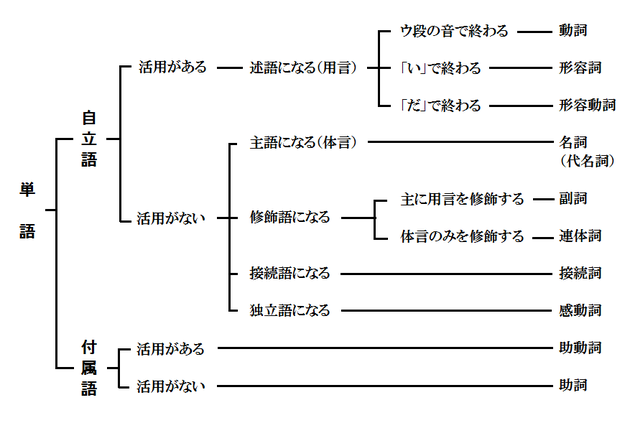
連体詞 are independant words (自立語) which are not conjugated (がない) and modify other words, more precisely noun (のみをする). And they are opposed to... 副詞 which modify 用言 (conjugeable words).

So, trying to mix the two system will just lead to confusion since it only make sense when you have the whole picture. But if you study that system properly, you learn about the 連体詞 quite early (If you searched for , you will found easily a few middle school ressources and it's amongst the first things that you learn).

At the same time, it's not necessary since it's like studying two grammar (so it's kinda double the work). But it can be useful for those who are interested and like grammar. If you want, you can check that site which is quite good (JP only tho): https://www.kokugobunpou.com/ (The image come the -> (3) section)

2
15 hours ago
avatar
Icepick87
Level: 623
Shamugan (052, 17:29)

It's no really more of an "advanced" concept but just a different system/classification altogether.
So trying to make sense of that concept in the system it doesn't belong to will confuse you.

As someone who is a beginner, this is a subject that I have yet to be taught. It being a different classification is a mutually exclusive matter. I do not see where I even said they were in the same classification.


Shamugan (052, 17:29)

For example, you said that cannot be conjugated. But it's even more than that since it's part of their definition.

​I said that for the OP who was asking how to tell the difference between adjectives, just to keep the whole thing simple. It wasn't about its definition.


Shamugan (052, 17:29)

So, trying to mix the two system will just lead to confusion since it only make sense when you have the whole picture.

​Again, where did I mix the two? The only point of confusion is when you generalize な-adjectives since they're not adjectives which end with the い okurigana except the two words, one might think that some adjectival words are な-adjectives. So, one difference to that is the fact they aren't words that conjugate, which would make it , which is all I said about that.

0
14 hours ago
avatar
Shamugan
Level: 764

Never mind. It seems I made a mistake by reacting to your post.
But don't worry, I won't do it again.
Have a good day.

1
37 minutes ago
Getting the posts


Top > 日本語を勉強しましょう / Let's study Japanese! > Anything About Japanese


Loading the list
Lv.

Sorry, there was an error on renshuu! If it's OK, please describe what you were doing. This will help us fix the issue.

Characters to show:


Use your mouse or finger to write characters in the box.
■ Katakana ■ Hiragana