I want to experiment with renshuu since I feel a bit stuck since quite some time but I want to be sure I'm not missing anything.
Main question is: what happen past mastery 9? Does it just repeat the same interval?
I had the impression that I've seen multiple term past level 9 multiple time but maybe, it's because I have "slow and thorough" enabled? I also changed level 9 to 999 at some point (to not have to remove manually the term which I often do). But maybe the few term that I saw were the term that I learned when I started renshuu. That's my first question.
The whole idea behind those experiment is to overstudy or understudy some terms as well as studying some terms for a short and studying others indefinitely.
For example, I want to use shorter and more regular interval for kanji. Even past level 9. Because kanji are more abstract, general term that I need to review continually. On the other hand, I want to study sentences in rapid burst and then quickly get ride of them. Since they are not benefit to study them for a long time. Quantity and short exposition, similar to reading, are the main benefit. But unlike reading, it's not random and it make review the same things. So it's also faster and more efficient.
And lastly, I also have some schedule that I could customize differently. Like a miscellaneous word schedule that I can afford to understudy. Because I mainly add words from immersion (youtube) or from my Japanese friends. Usually, those terms are easier to remember simply because they're related to things that I like, because I heard them in a joke and more generaly, because they're more important for some random reasons that my brain decide to choose. The opposite are words that I force myself to learn. Like words to learn the kanji readings and meanings. Those words are also easier but for different reasons and I don't have the same objective with them too. Most important difference, and I use renshuu a bit weirdly here, I'm not... trying to remember them x). Similar to sentences, the main benefit is just quantity and short exposition. And I don't mind studying again if they become more important at some point. At that stage, it's just mostly a guessing game rather than properly studying words. And immersion will decide if I need to study properly or not later (which I probably won't need for a lot of them since recognizing them in context is enough).
Oh and also, for all of those different case, I adjust how strict I am towards myself too. Dropping the mastery to 0 has been quite useful recently. I think I finaly graduated from wanting to learn fast :'). Well, mostly since I'm still wasting time trying to be more efficient here . But I also enjoy reviewing old words/kanji to learn deeper nuances and I'm not bothered anymore when I forgot a word or basic reading/meaning
Anyway, besides the initial question, is there something I should know regarding how renshuu work in order to be sucessful with my experiement?
Oh, and for the sentence memo, is it possible to format the input to automatically fill the memo? Like for the translation, you just the "=". Something like that: ご飯できたよ!=Dinner is ready! (Casual household speech) The text in the parenthesis will fill the memo automatically. I think that feature can so powerful but is also too underused...
Anyway, if マイコー or someone else could enlight me on that, I would be very grateful :D (or just if you have something to add too)
Shamugan (08月4日, 16:15) Main question is: what happen past mastery 9? Does it just repeat the same interval?
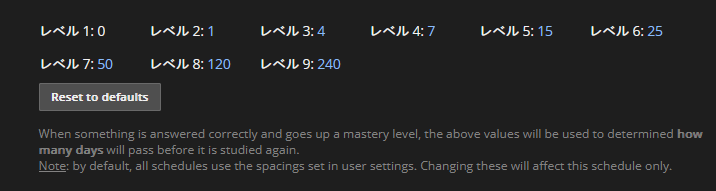
Yes. Let's say you have an interval of 365 days for level 9, that term will keep coming up for review at intervals of 365 days. I'm also pretty sure changes in intervals don't apply retroactively. So if you changed your level 9 interval from 365 to 999, that won't apply to terms already on the 365 interval (should apply next cycle).
I think when you manually set mastery, that uses your global "Mastery level spacing". At least that makes the most sense to me, since terms aren't inherently tied to schedules and taking into account which schedule they're currently being viewed from is extra coding that Michael probably hasn't bothered with.
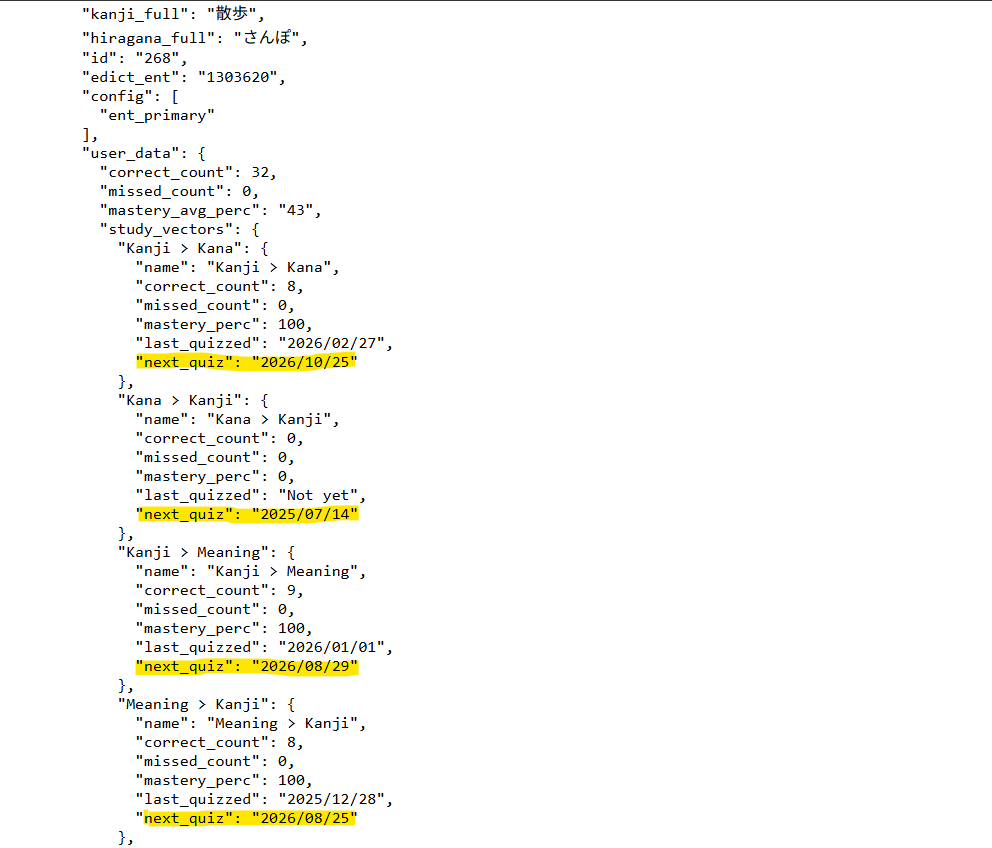
SRS intervals are "global" and tracked on the terms themselves. You can see this using the API:
(this is all based on my own observations and a few threads I vaguely remember reading)
Hum, okay, then if they are no tricky part and having multiple vector enabled, for example, doesn't affect really anything, I think I could try a few things.
I could create a list or schedule with similar kanji, reading or radical to raise the difficult and study them in short burst. One of the thing that I found difficult to work on with renshuu are relations between terms (synonym, opposite, homophone, etc). SRS are not good at that and later, you realize that you can't differentiate 待、持、特、侍 or 寺 because you never saw them side by side. I mean, for those, I'm already good but I'm pretty sure there are other that I am not conscious of. And even when I'm conscious, it doesn't mean it's enough. Well, it could and in the long term, immersion will solve that but in the same, I'm annoyed since I know they exist and I can't do that much. One by one is inefficient and creating custom list take too much energy (also not my current priority). The experimental feature which pull terms from the current schedule look interesting tho. "Just" need to create some lists.... There is too much things to do and I'm impatient
ugh, I want to try something with the radical name too now...
Anyway, thanks for the confirmation, I can try a few things with that piece of information now
....
Just realized something, "I think when you manually set mastery, that uses your global "Mastery level spacing"." Then what about the schedule custom mastery setting?
That the one that I intended to use x). Which now beg the question of what happened with multiple schedules with different custom mastery with the same terms? The first review overide the others?
"Which now beg the question of what happened with multiple schedules with different custom mastery with the same terms? The first review overide the others?"
Yup, just tested it :D
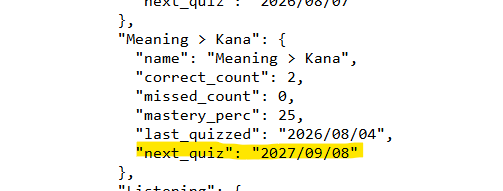
I guess I'll have to wait for a few days to make sure, but this IS pulled from the schedule that's meant to have an interval of 3 days.

 . But I also enjoy reviewing old words/kanji to learn deeper nuances and I'm not bothered anymore when I forgot a word or basic reading/meaning