和英辞典Vocabulary dictionary

漢字辞典 Kanji dictionary

文法辞典 Grammar dictionary

例文検索 Sentence lookup

test
 

掲示板 Forums - Japanese Linguistics or Bug/Mistake?

Top > renshuu.org > Questions about renshuu


avatar
ナカモ
Level: 40

(I had to compress the title a bit because of characters limit so I wrote this way instead of: Is there a japanese linguistics reason for this or is it a bug/mistake?)

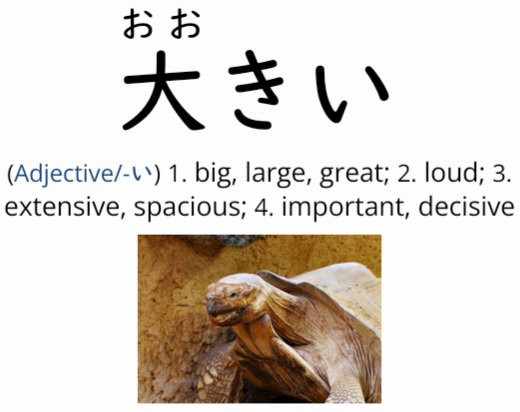
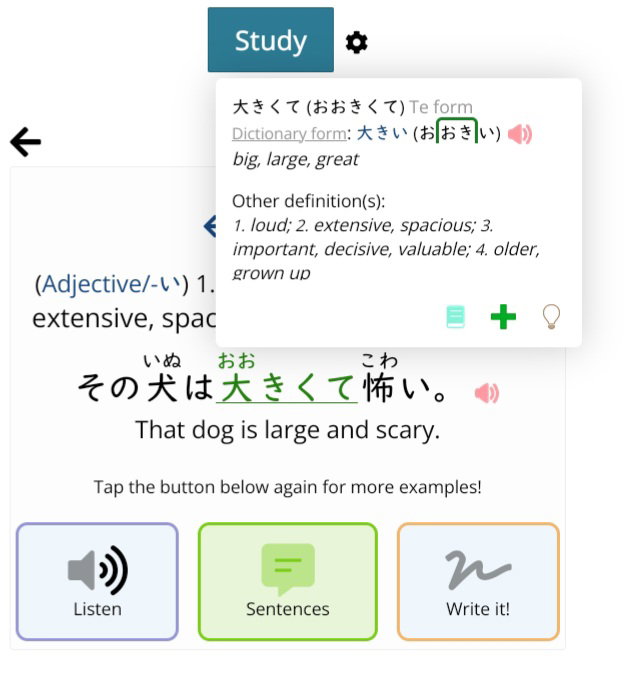
Wondering what I'm missing out, as I was learning I got to the word 大きい (おおきい) and when I went to check for a sentence the first one being shown (I refreshed page because I didn't realise I could just click again for another, good I noticed the hint near the button - this sentence, by the way, is default for this word atm): その犬は大きくて怖い。

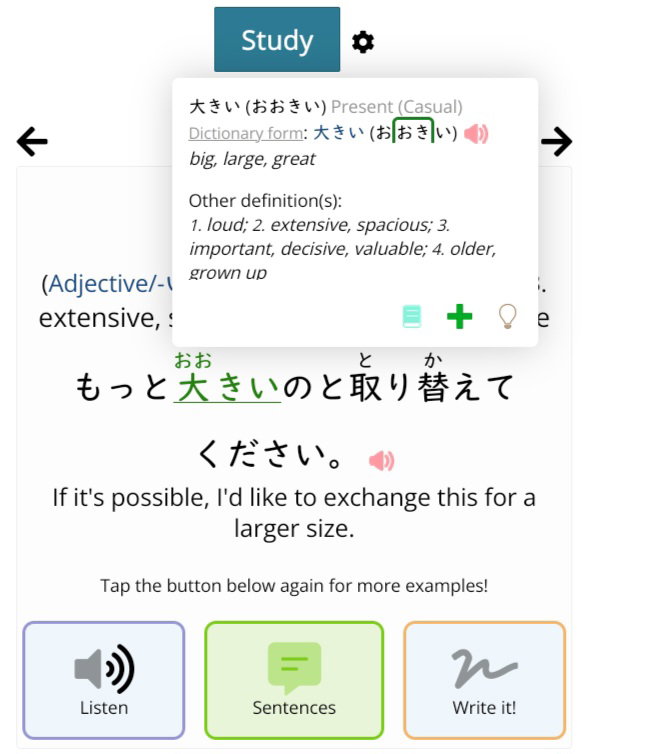
As a beginner I got confused with the reading and clicked again for another then I got もっと大きいのと取り替えてください。
This one looked more appropriate for someone with my current knowledge of japanese because the reading is exactly as it was presented on the front of the word when being introduced, the first sentence it reads as おおきくて instead of おおきい
Also, it presented to me tagged with Adjective/-い (I still need to grasp better about it) but you can see where someone lacking the knowledge being shown the first sentence may look confusing as an example

I don't mean to judge the sentence being there at all but just wanted to confirm what I ask in the title (and to understand), is this a correct sentence for the word and my lack of knowledge is why I don't get it or is it there for this word by mistake/some bug happening?


bc2f6a1644b8a03e7b567f5a.jpg


42dba478b7ef78eac6a25f1b.jpg
735ac0a16b4b508acf0d0968.jpg
3
5 days ago
avatar

The sentence is correct, you just haven't learned about the Te form and linking adjectives yet.

Here's the relevant grammar point: https://app.renshuu.org/gramma...


おおきい と こわい ❌ (the wrong way to express "and" for adjectives)

おおきくて こわい ✅ (the right way to express "and" for adjectives)


For い-adjectives you drop the final い and replace it with くて, e.g. おおきい → おおきくて


So when connecting adjectives, you use the て/で form. Basically, you conjugate every adjective except the last one.

For い-adjectives:

  • 可愛い → 可愛くて
  • 強い → 強くて

Example: 可愛くて、強くて、優しい ...


For な-adjectives:

  • 静か → 静かで
  • 安全 → 安全で

Example: 静かで、安全で、素敵な ...


※ The only common exception is いい ("good"), which becomes よくて. You can read the usage notes for more information.

7
5 days ago
avatar
雪・にゃー
Level: 302

The above comment is right, but I also want to point out you can turn any い-adjective into an adverb by changing い to く. So 遅い(おそい)​ is slow and 遅く(おそく)​ is slowly. Notice we do something similar in English by adding ly to the end of some adjectives to create adverbs.

This is essentially what's happening with い-adjectives in the て form. You turn it into an adverb and add て. Most people just think of it as dropping い and adding くて, though.

This pattern comes up in other conjugations as well, like 大きくない, not big.

6
4 days ago
avatar
Mrs_Diss
Level: 542

also, just generally, the example sentences show the words in their conjugated forms.

you can generally click on a word and you’ll get a little pop up showing the word in its dictionary form and a note what form it’s taken in the sentence.

i really like being able to see vocab in context, including conjugated forms, but as a beginner i agree that it can be a little confusing.

6
4 days ago
avatar
ナカモ
Level: 40

@ギョルギ九十三 thanks a lot for the explanation (including the wrong way to use it, it's quite nice to be able to see contrast on what to and what not to when learning imo) and letting me know there are exceptions kao_shock.pngneko_what.png

@雪・にゃー fascinating bit of info thanks, i am definitely writing it down so i don't forget about it neko_cheer.png kao_eating.png

@Mrs_Diss ohh.. this went right over me without glasses, i was practicing now with glasses and read your comment and noticed it, the text color contrast didn't help much to notice it kao_horror.png but then if there was maybe it would look too cluttered i suppose kao_ponder.png i will try to remember putting my glasses on so this kind of thing doesn't go unnoticed by me again kao_sorry.pngkao_heart.png

3
17 hours ago
avatar
Icepick87
Level: 645
Welcome to the world of conjugations (some folks hate to use the word, but it is what it is about)! It's not uncommon to instead call it "forms" or "inflections" of the word. This also goes way back to Old Japanese.

If you see a thing like that, but it doesn't look like the full spelling, chances are, it's not a spelling error. Not unless you know what is being used. It is really just the same way that works in other languages when you add suffixes like -ly, -ing, -ed, and the like. Sometimes you also have to change the spelling even in English like if the letter ends in Y. For Japanese, you may have to do that, or, depending on some forms, you have to add another term and you can change the tense of that term from there instead.

The easiest part is knowing that there are these patterns and it's simple to follow. Unfortunately, the hardest part of Japanese is that this entails an amount of sophistication that is hard to memorize, as there are MANY possible ways. And on top of that, there's different levels of formality you may have to change the sentence to have the proper way to address the audience.

And, for that word in particular, there's also another example which may also throw you off. Fromt he same word, you can also have a form spelled such as 大きな instead of おおきい. There is a difference, both for nuance and purpose, but they share the same root of that word. So some words are spelled differently with the same principle, likely because the ending gives the base word its classification, and it basically has a particular function, which is why you have to modify that part for different forms.
5
14 hours ago
Getting the posts


Top > renshuu.org > Questions about renshuu


Loading the list
Lv.

Sorry, there was an error on renshuu! If it's OK, please describe what you were doing. This will help us fix the issue.

Characters to show:


Use your mouse or finger to write characters in the box.
■ Katakana ■ Hiragana