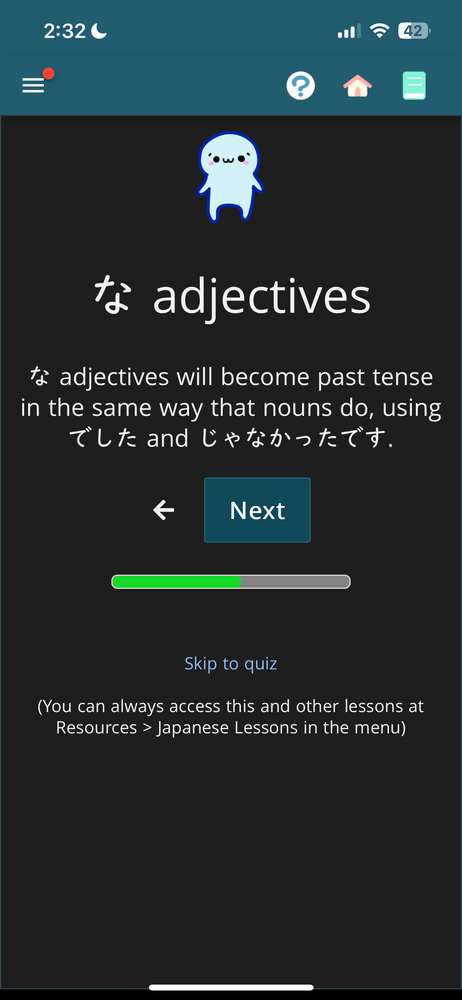
As I understood when making a noun or na-adjective past tense datta is added not katta. Yet when I just did lesson 12 or 13 of the Japanese Basics schedule it said to use katta repeatedly. Google results say to use datta. I feel like I'm misunderstanding something as I doubt the lesson is incorrect, could anyone help me out? (Maybe my brain isn't working this late!)
だった is the past tense of the copula だ, so any phrase that would take the copula in plain non-past form will use だった in past tense. Nouns and な-adjectives grammatically are followed by a copula when they end a sentence, which is why the instructions for making them past tense is simplified to just "add だった to nouns & な-adjectives".
い-adjectives act differently, and instead of taking the copula and having the copula change tense, they get conjugated themselves, like verbs do. To conjugate an い-adjective in the past tense, you replace the い with かった.
The plain negative ない form is actually an い-adjective itself, so any past tense negative phrase will conjugate with かった as well.
Another potential source of confusion is that なかった looks like it might have something to do with the な in a な-adjective. It doesn’t. The adjectival -な is only used when modifying another noun, e.g., 小さな空. As mentioned above, the な in なかった is the root of ない.
But I do not understand げんき じゃなかった です ist the same as げんき でした (polite/formal) it should be げんき ではありません でした, right?
じゃないです and ではありません are equivalent phrases. They are both correct and mean the same thing, they're just arrived at by applying politeness and negation in the opposite order. ではありません used to be considered the standard way to form the polite negative, but for the past few decades じゃないです has been gaining so much popularity that that's the way you're most likely to hear it.
The copula だ is a contraction of the phrase で ある. To make it negative, the で becomes では (which can be contracted to じゃ), and then you conjugate ある. The plain negative form of ある is the adjective ない, and to make it polite you add です after it. But you could also make ある polite BEFORE you make it negative, and so it would be あります→ありません.
では=じゃ
ないです=ありません
The past tense is the same way, so なかったです = ありませんでした.
But I do not understand げんき じゃなかった です ist the same as げんき でした (polite/formal) it should be げんき ではありません でした, right?
じゃないです and ではありません are equivalent phrases. They are both correct and mean the same thing, they're just arrived at by applying politeness and negation in the opposite order. ではありません used to be considered standard way to form the polite negative, but for the past few decades じゃないです has been gaining so much popularity that that's the way you're most likely to hear it.
The copula だ is a contraction of the phrase で ある. To make it negative, the で becomes では (which can be contracted to じゃ), and then you conjugate ある. The plain negative form of ある is the adjective ない, and to make it polite you add です after it. But if you could also make ある polite BEFORE you make it negative, and so it would be あります→ありません.
では=じゃ
ないです=ありません
The past tense is the same way, so なかったです = ありませんでした.
Thank you very much for explaining. But I meant that screenshot. It says:
"な-adjective will become past tense[...] でした and じゃなかったです",
but じゃなかったです is "past negativ" not just past tense, right? So it should be phrased as
"な-adjective will become past tense[...] でした and だった."
-------
Because ではなかった/じゃなかった are negativ past, same goes for ではなかったです/じゃなかったです or ではありませんでした/じゃありませんでした.
Thankyou everyone for your help, I understand now from all your help that だった is casual non-negative/positive and extension of だ, and かった is used in the negative past tense (casual).
Thankyou everyone! Such a wonderful community ^.^
P.S I realise I made a typo I meant to type "katta repeatedly" but you all understood anyway - very smart!